



GMC HUMMER EV Home Charging: A Burlington Owner's Guide
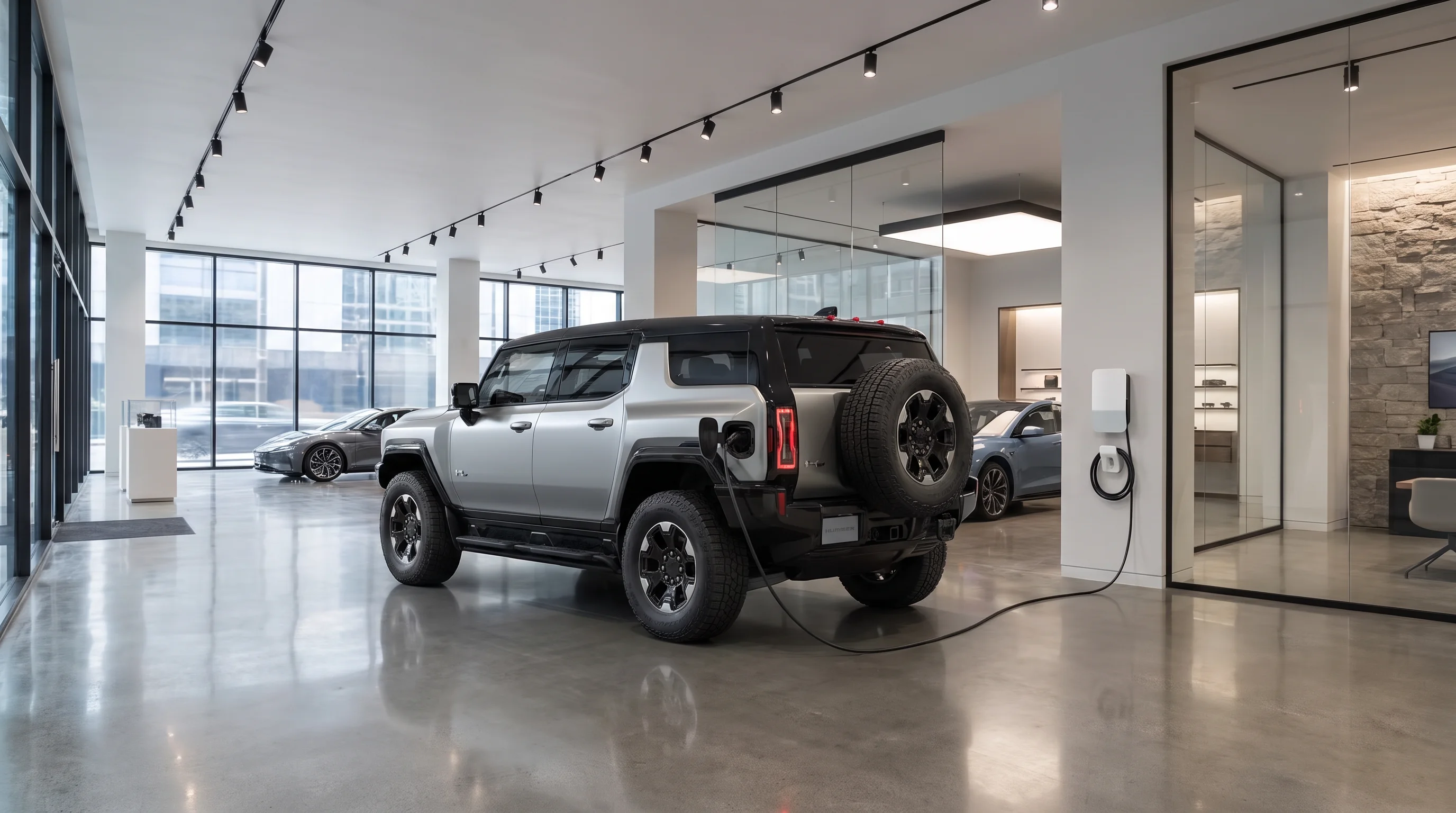
The GMC HUMMER EV asks more of a home electrical system than almost anything else on the road. Level 1 charging, meaning a standard 120-volt household outlet, adds only a few miles of range per hour. On a vehicle in this class that is a trickle, not a strategy.
A dedicated Level 2 station running on a 240-volt circuit is what makes overnight charging practical. That is the same kind of service a clothes dryer or electric range uses. Before you plan a garage layout or call an electrician, it helps to understand what the hardware actually does and what your panel can support. Our team can walk you through the options, and you can find our hours and directions whenever you want to talk it through in person.
How Much Range You Are Actually Refilling
Range varies by trim and battery pack, and the spread is wide enough to change how you think about charging. The figures below are GM-estimated for the HUMMER EV Pickup.
| Configuration | Battery Pack | GM-Estimated Range |
|---|---|---|
| HUMMER EV Pickup 2X | 20-Module | Up to 316 miles |
| HUMMER EV Pickup 3X | 20-Module (standard) | Up to 312 miles |
| HUMMER EV Pickup 3X | 24-Module (available) | Up to 363 miles |
A battery in that range takes real infrastructure to refill, which is why the amperage of your circuit matters more than the brand on the wall box.
EPA-estimated fuel economy figures are for comparison purposes only. Your actual mileage will vary depending on driving conditions, how you drive and maintain your vehicle, battery age/condition, and other factors.
Choosing the Right Amperage for Your Charger
A home charger's speed is set by the amperage of the circuit it occupies. EV charging counts as a continuous load under the National Electrical Code, so the circuit behind any charger must be sized at 125% of what the charger draws. That single rule explains every number below.
The 19.2 kW Setup: 80 Amps on a 100-Amp Circuit
At the top of the residential range sits 19.2 kW. That is the maximum output of GM's own PowerShift Charger, which draws up to 80 amps of continuous current. Apply the 125% rule and an 80-amp charger needs a dedicated 100-amp circuit behind it. Both numbers get quoted, and both are correct. Eighty amps is what the charger pulls. One hundred amps is what the circuit must be rated for.
The 11.5 kW Setup: 48 Amps on a 60-Amp Circuit
Not every home is ready for 100 amps. A 48-amp charger on a 60-amp circuit delivers roughly 11.5 kW and is the more common residential setup by a wide margin. It charges more slowly. But for a driver with eight to ten hours of overnight dwell time in the garage, slower is rarely a problem.
Which One Do You Need?
The choice usually comes down to how much headroom you want. GM rates the 19.2 kW PowerShift at up to 67% more power than an 11.5 kW charger. That matters if you regularly come home with a low state of charge after towing or off-roading, or if a second EV is in your future. If your commute is short and your panel is near capacity, a 48-amp unit will serve you well without a service upgrade.
| Charger | Max Output | Max Current | Required Circuit | Home Backup Support |
|---|---|---|---|---|
| GM Energy PowerShift Charger | 19.2 kW | 80 amps | 100 amps | Yes, with V2H Enablement Kit |
| GM PowerUp 2 Charger | 11.5 kW | 48 amps | 60 amps | No |
| Tesla Universal Wall Connector | 11.5 kW | 48 amps | 60 amps | Not for GM vehicles |
GM Energy Hardware: PowerShift and PowerUp 2
GM sells its own home charging hardware through GM Energy, and the lineup is short enough to be easy to navigate.
GM Energy PowerShift Charger
The GM Energy PowerShift Charger is the flagship. It delivers up to 19.2 kW at 80 amps and ships with a 25-foot cable. Critically, it is the only GM home charger that supports bidirectional power. If home backup is anywhere in your plans, this is the unit that enables it.
GM PowerUp 2 Charger
The GM PowerUp 2 Charger is the streamlined alternative at up to 11.5 kW. It moves power in one direction only, from the grid into the vehicle. For owners who want GM-branded hardware without the complexity or cost of a backup system, it does the job.
Installation and App Integration
Either way, GM requires professional installation and points owners toward Qmerit as a GM-preferred installer. That relationship matters less for the paperwork than for the commissioning. A properly installed system talks to your vehicle correctly, which is what makes scheduled charging and energy monitoring work through the myGMC app.
If you are still deciding whether an EV fits your driveway at all, it is worth browsing the electric and hybrid vehicles at Lynch GMC of Burlington before you invest in charging infrastructure.
Electrical Safety and Professional Installation
Installing a charger for a vehicle with these power demands is not a DIY project. Sustained high-current draw stresses a home's electrical system in ways ordinary appliances do not.
Start With a Load Calculation
A licensed electrician should start with a load calculation on your existing service panel to confirm it can carry the additional draw. That is 48 amps for a mid-tier charger and 80 amps for the PowerShift. Older homes may need a panel or service upgrade before either is safe to add.
Why 48-Amp and Larger Chargers Must Be Hardwired
This is not a preference. A cord-and-plug charger on a NEMA 14-50 receptacle is limited by code to 80% of the 50-amp breaker, which caps continuous output at 40 amps. Any charger rated above that, including both the 48-amp and 80-amp units discussed here, has to be hardwired. Hardwiring also removes the plug-and-socket junction, which is the component most likely to degrade under the heat of repeated high-load charging. An undersized circuit or a loose connection generates heat, and heat is what damages chargers, vehicle charge ports, and occasionally more than that.
Permits, Code, and Salt-Belt Protection
Permits and local code compliance are part of a correct installation, not optional extras. Code editions and requirements vary by jurisdiction, so your local authority has the final word. A certified installer will use the proper copper gauge, protect the circuit with the right breaker, and position the unit for sensible cable management. In the salt-belt conditions around Burlington, sealing exterior conduit and connections against moisture and road-salt corrosion is worth insisting on.
Vehicle-to-Home Backup Power
The 2026 HUMMER EV is Vehicle-to-Home capable. GM Energy lists both the HUMMER EV SUT and SUV among its V2H-capable vehicles. A properly equipped truck can send power back out of its battery to a properly equipped home during a blackout.
What You Need
- A V2H-capable GMC HUMMER EV
- The GM Energy PowerShift Charger
- The GM Energy V2H Enablement Kit
What the Enablement Kit Includes
The kit is three components, and each one earns its place:
- Home Hub — controls your home's energy grid and performs the disconnection from the public utility grid
- Inverter — converts DC power from the vehicle into the AC power your house runs on
- Dark Start Battery — stores enough energy to bring the system up when the grid is already down
That grid disconnection is the safety feature that makes the whole thing legal and sane. Without it, a vehicle feeding power backward into utility lines would endanger the crews working to restore service. Once the home is isolated, the HUMMER begins supplying the panel.
How Much Power It Actually Delivers
One number is worth knowing before you budget. The PowerShift sends up to 9.6 kW of discharge power to the home. That is the backup figure, not the 19.2 kW charging figure. The two are different ratings for different directions, and confusing them leads to disappointed expectations about what the system will run.
PowerShift vs. the Tesla Universal Wall Connector
Plenty of HUMMER EV owners weigh GM's hardware against the Tesla Universal Wall Connector. It is a fair comparison worth making honestly.
The Tesla unit is popular for good reason. It carries an integrated J1772 adapter, so it charges the HUMMER's CCS inlet without a separate dongle to lose, and it delivers up to 11.5 kW at 48 amps. Separately, for DC fast charging on the road, GM offers a NACS DC Adapter that opens up NACS fast-charging stations to CCS-equipped vehicles. That adapter is for DC fast charging only and does not work for Level 2 home charging.
Where the two diverge is speed and direction. The Tesla connector tops out at 11.5 kW, about 40% slower than the PowerShift's 19.2 kW. And while Tesla does offer home backup through its Powershare technology, that capability is currently limited to the Cybertruck. It does not extend to GM vehicles. If you want the fastest home charging available and the ability to power your house during an outage, the GM Energy hardware is the one that does both.
HUMMER EV Home Charging FAQs
How long does it take to charge a GMC HUMMER EV at home?
It depends entirely on your circuit. A 19.2 kW PowerShift Charger on a 100-amp circuit is the fastest residential option GM offers and delivers up to 67% more power than a typical 11.5 kW unit. An 11.5 kW charger on a 60-amp circuit is slower but still recovers a normal day's driving comfortably overnight. Actual rates vary with battery condition, vehicle settings, and outside temperature, so treat any single figure as an estimate rather than a promise.
Should I hardwire the charger or use a 240V outlet?
For the chargers discussed here, hardwiring is required rather than recommended. A NEMA 14-50 receptacle caps continuous charger output at 40 amps under electrical code, so any 48-amp or 80-amp unit must be hardwired. Hardwiring is also more robust, is required to reach the full 19.2 kW, and holds up better under the sustained high current the HUMMER EV draws.
Will Burlington winters affect my home charging?
Yes, in two ways. Cold slows the initial charge rate while the vehicle warms the battery to an efficient temperature, and cold reduces driving range. Independent testing puts average EV range loss around 20% at freezing, with deep-cold conditions pushing considerably higher. One 2026 dynamometer study of six current EVs measured roughly 39% at 20 degrees Fahrenheit. Preconditioning the battery and cabin while the vehicle is still plugged in uses grid power instead of battery power, which preserves range for the road. Garaging the vehicle while it charges helps as well.
Can the HUMMER EV power my house during a blackout?
Yes, with the GM Energy PowerShift Charger and the GM Energy V2H Enablement Kit installed together. The system isolates your home from the grid and then supplies your panel from the vehicle battery, at up to 9.6 kW of discharge power. Backup duration depends on your household's energy use and the vehicle's state of charge.
Do I still need a wall-mounted charger?
For daily use, yes. Level 1 charging from a standard 120-volt outlet adds only a few miles of range per hour. That is fine for an occasional top-off but impractical as a primary method for a battery this large. A dedicated Level 2 station is what makes the vehicle ready every morning.
Talk to Lynch GMC of Burlington About Your Charging Setup
Getting a HUMMER EV home means getting your garage ready first. The decisions, including amperage, hardwiring, and whether backup power is worth the additional hardware, are easier to make with someone who knows the Ultium platform. Our team can talk through what your property will support and help you coordinate with a certified installer.
You can also explore the rest of our GMC model research if you are still narrowing down which vehicle fits. We are at 2300 Browns Lake Drive in Burlington, Wisconsin.
Disclaimers
EPA-estimated fuel economy figures are for comparison purposes only. Your actual mileage will vary depending on driving conditions, how you drive and maintain your vehicle, battery age/condition, and other factors.